Fuzhou, on the Min River in Fujian, on a summer night. The jasmine was picked around noon, still closed, and kept cool. At about nine, as the flowers begin to open, they are layered over beds of dry green tea and left for a day. Then the spent flowers are sifted out, the tea is dried, and it is done again with fresh flowers, up to seven times for the top grades. The tea learns the scent overnight. Jasmine blooms most from April to September, so spring tea waits for summer flowers.
The flower is not Chinese. Jasminum sambac is native to India and the eastern Himalaya, and is thought to have reached China in the Han dynasty. Fuzhou grew it as early as the Western Han and calls itself the City of Jasmine; the tea is its local drink. In 2014 the FAO named the Fuzhou jasmine-and-tea landscape an agricultural heritage site: tea on the terraces, jasmine on the river flats. Robert Fortune found it sold in the Min valley's markets, bought by women to wear in their hair.
The flower has a song. Mo Li Hua was one of the most popular songs in the country when John Barrow heard it on Lord Macartney's embassy to the Qianlong Emperor in 1793; Barrow printed it in London in 1804, and Puccini gave it to Princess Turandot. In the south of China a cup of jasmine tea is how a guest is greeted.
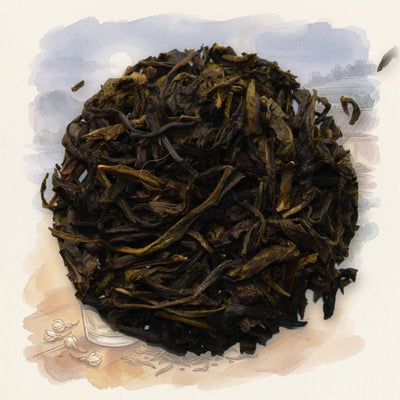
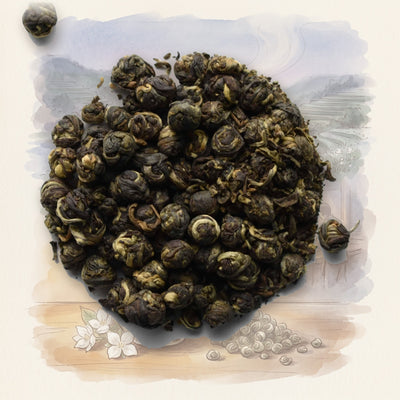
Silk Dragon Jasmine, Organic is the loose leaf, the welcome cup. Jasmine Dragon Pearls, Organic is the same tea rolled into small balls that open slowly in the glass, the one for the dim-sum table.