In 1391 the Hongwu emperor decided the court would accept only loose tea as tribute. The compressed cakes that had been ground and whisked for centuries stopped going to him, production shifted to whole leaf, and by the end of the sixteenth century loose leaf had replaced cake and powder across China. A leaf that steeps whole needs somewhere to do it. That is the teapot's entire argument.
The pot travelled with the leaf. Tea reached Europe with the Portuguese in the sixteenth century, and the Dutch East India Company's first recorded shipment sailed from Macao to Java in 1607. Samuel Pepys wrote down his first cup, a China drink, in 1660; two years later Charles II married Catherine of Braganza, who brought Portugal's tea habit to the English court, and the pot followed the cup into every house that could keep one.
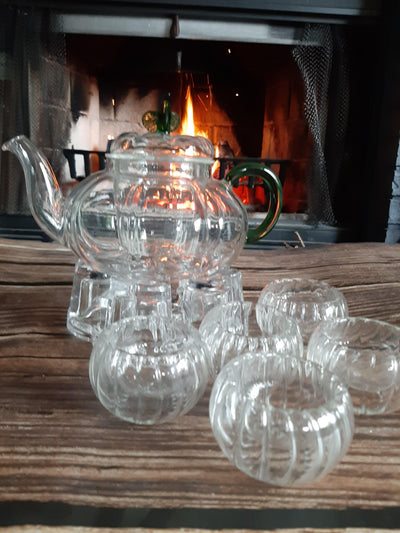
What a pot is made of decides what it can do. Glass holds nothing from the brew before it, so one pot can serve a smoky black in the morning and a chamomile at night without either tasting of the other. It also shows the part worth watching, a rolled leaf taking on water and opening out to the size it was on the bush. Cast iron does the opposite and keeps its heat long after the stove is off, which is why a hot pot wants something under it.
So the shelf is small on purpose. Kid's Glass Teapot - 2 Cup is two cups of clear glass, enough for one drinker or a child's first pot of their own. 4 Cup Pebble Teapot is the table size, a pot poured twice. Cast Iron Trivet-Black and Cast Iron Trivet- Rusty Brown go under either of them, and under a hot skillet the rest of the week.