
Ingredients · Flower
Cornflower
Centaurea cyanus · Asteraceae (daisy family)

What it’s like, and how to use it
How to use it
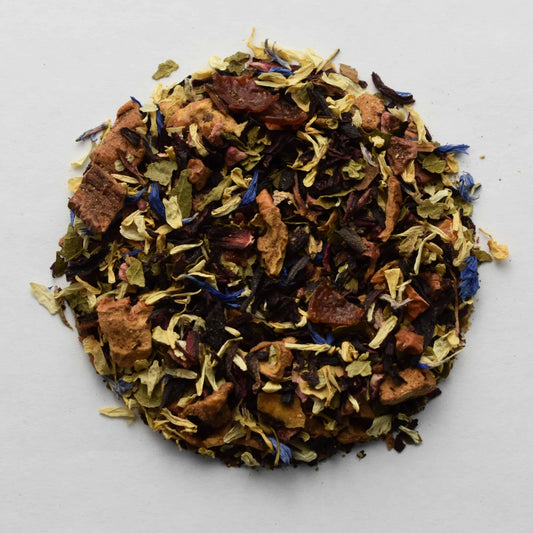
Scattered into a blend for colour. It holds its blue through boiling water, which is unusual. Also used to decorate cakes and salads, where it is doing the same job. There is no reason to use it for flavour and no harm in using plenty.
With food
Anything it is scattered on — it is a visual ingredient rather than a flavour one.
With spices
Bergamot, in Lady Grey. Rose and lavender, for a flower blend that reads as deliberate.
With tea
Earl Grey and Lady Grey. White tea and pale greens, where blue shows best. Rooibos, for the contrast against red.
Its story
Where it comes from
Native to Europe and now naturalised widely, including in North America and parts of Australia. It was once a common weed of grain fields — which is where the name comes from, corn in the British sense of cereal — and that is no longer true: it is endangered in its native habitat by agricultural intensification, and in the United Kingdom it declined from 264 sites to just three in fifty years. Better seed cleaning, heavier nitrogen and herbicides did it.
What happened
A flower that ended up on several countries' emblems. It has been the national flower of Estonia since 1969, and it is one of the national symbols of Germany, through Queen Louise of Prussia. In France it is the bleuet de France, the flower of remembrance for veterans and for the armistice of 1918 — the French counterpart to the poppy worn across the Commonwealth. There is something worth noticing in that: a weed of wheat fields became the emblem of the men who fought in those fields, and then very nearly disappeared from them.
On the shelf with it
Every product it goes into.
-
Blueberry White, Organic
Regular price From $15.00 CADRegular price -
Cream of Earl Grey
Regular price From $1.00 CADRegular price -
Blueberry Bang Rooibos
Regular price From $9.00 CADRegular price -
Earl Grey, Rooibos
Regular price From $9.00 CADRegular price -
Blueberry Bang
Regular price From $10.00 CADRegular price -
Earl Grey, Green
Regular price From $9.00 CADRegular price -
London Calling
Regular price From $9.00 CADRegular price -
Breakfast In Paris
Regular price From $9.00 CADRegular price -
-
Champagne White
Regular price From $15.00 CADRegular price -
Buckingham Palace Garden Party
Regular price From $9.00 CADRegular price -
Almond Biscotti
Regular price From $9.00 CADRegular price -
Earl Grey Blue Flower, Organic
Regular price From $8.00 CADRegular price -
Plum Sesame "NEW"
Regular price From $10.00 CADRegular price -
 Sold out
Raspberry Lemonade, Organic
Regular price From $10.00 CADRegular price -
 Sold out
Oolong Berry Blend
Regular price From $10.00 CADRegular price -
 Sold out
Sleigh Ride
Regular price From $10.00 CADRegular price$9.00 CADSale price From $10.00 CADSold out -
 Sold out
Maple, Eh! Organic
Regular price From $9.00 CADRegular price


