
Ingredients · Flower
Safflower
Carthamus tinctorius · Asteraceae (daisy family)

What it’s like, and how to use it
How to use it
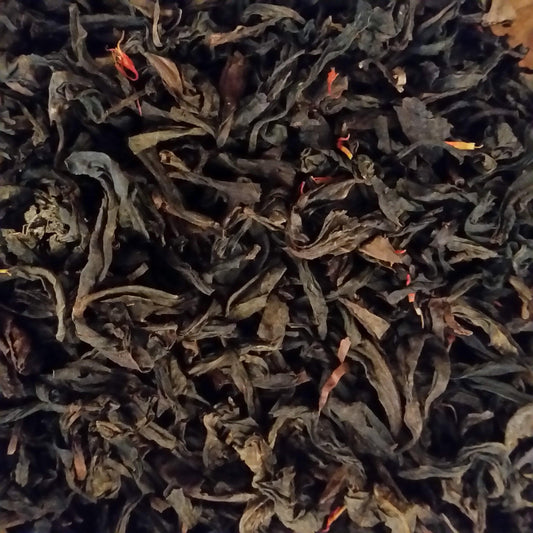
Steeped with rice, paella, biryani or risotto for colour — a pinch turns the pot gold. Scattered on salads as a garnish. In tea blends it is a visual ingredient: the orange threads in a pale fruit tea are usually safflower. Brewed on its own it makes a golden, faintly bitter cup.
With food
Rice and grains. Chicken and fish. Saffron's own partners — almond, honey, citrus — though without saffron's depth to meet them.
With spices
Turmeric, which does the same colour job with more flavour. Cardamom. Cinnamon. Rose.
With tea
Rooibos, white tea and oolong, where the orange threads show. Hibiscus and rosehip.
Its story
Where it comes from
Native to arid lands with seasonal rain, first cultivated in Mesopotamia, possibly by 2500 BC. It travelled through India and the Silk Road to China, where it arrived over 2,100 years ago, and on to Japan between about AD 200 and 500. Today's crop is grown mostly for oil in California, North Dakota and Montana, and on the Canadian prairies in Saskatchewan and southern Alberta.
What happened
Safflower dye has been found in Egyptian textiles of the Twelfth Dynasty, between 1991 and 1802 BC, and safflower garlands were laid in Tutankhamun's tomb. In Japan it became benibana, and by the Edo period the Mogami valley of Yamagata grew the best of it: the flowers were pressed into cakes, shipped down the river to Sakata and by sea to Kyoto for the Nishijin weavers and the rouge-makers who painted the lips of the court. Beni, at the time, was a product as expensive as gold. In the summer of 1689 the poet Basho stayed at Obanazawa with a safflower merchant called Suzuki Seifu, a wealthy man they called a benibana tycoon, and wrote a haiku in which the flowers recall an eyebrow brush. Chemical dyes ended all that in the Meiji period. On the Great Plains, trials began in 1925; the plant's taproot reaches eight to ten feet down into dry ground, which is why it belongs where it now grows.
On the shelf with it
Sold on its own, and in these blends.
-
Safflower, American
Regular price From $6.99 CADRegular price -
Strawberry White, Organic
Regular price From $15.00 CADRegular price -
-
Orange Creamsicle
Regular price From $9.00 CADRegular price -
Apricot Peach, Rooibos, Organic
Regular price From $9.00 CADRegular price -
 Sold out
Rest and Digest, Organic
Regular price From $10.00 CADRegular price -
 Sold out
Smoked Maple Oolong, Organic
Regular price From $16.00 CADRegular price -
 Sold out
Sleigh Ride
Regular price From $10.00 CADRegular price$9.00 CADSale price From $10.00 CADSold out -
 Sold out
Ayurvedic Om Sweet Om
Regular price From $9.00 CADRegular price -
 Sold out
Bengal Tiger Spice
Regular price From $10.00 CADRegular price


