Ingredients · Spice
Garlic
Allium sativum · Amaryllidaceae (amaryllis family)

What it’s like, and how to use it
How to use it
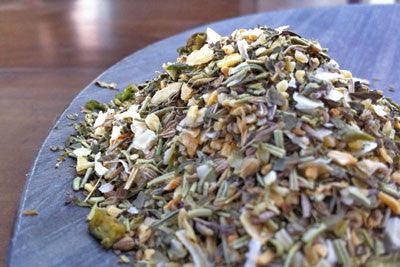
Granulated into rubs and long-cooked sauces, where it has time to soften. Minced where you want to see it — chili, marinades, roast potatoes. Powder into dressings, dips, compound butter, garlic bread and anything that has to stay smooth. A guide from McCormick, for its own products: one medium clove finely minced for each eighth of a teaspoon of garlic powder; for dried minced garlic, crush it and use an equal measure. Dried garlic burns fast — add it to the fat off the heat, or to the liquid.
With food
Tomato, olive oil and bread. Butter and parsley. Beef, lamb, chicken and pork. Potatoes in every form. Mushrooms. Lemon and anchovy. Yogurt and cucumber. Chile of any kind.
With spices
Onion, its sister bulb, in almost everything. Oregano and basil for Italian. Paprika and cumin for Spanish and Mexican. Black pepper and thyme for a roast. Ginger and chile for stir-fries.
With tea
Not a tea ingredient. If you are drinking something with a garlicky meal, a strong Assam or a smoky Lapsang Souchong stands up to it.
Its story
Where it comes from
Kew gives the native range as Central Asia to northeastern Iran — Iran, Kazakhstan, Kyrgyzstan, Tajikistan, Turkmenistan and Uzbekistan. The University of Wisconsin Extension calls the foothills of those ranges probably the true birthplace of garlic. Most of the world's dried garlic today comes from China, which grew 73% of the crop in 2024, or from California, where Gilroy has dehydrated garlic since the late 1930s. Which of those our lots come from is not something we can confirm without the supplier's record.
What happened
Garlic has been cultivated in Mesopotamia for at least four thousand years and was sealed into Tutankhamun's tomb around 1325 BC. Herodotus stood at the Great Pyramid and heard an interpreter read out the money spent on vegetables for the workmen. Numbers 11:5 is homesickness in one verse: in the desert, the Israelites remember the garlic of Egypt. Greek and Roman soldiers, sailors and country people ate it, and the Mishnah's nickname for Jews was "garlic eaters". In Korea's founding myth a bear is given twenty cloves of garlic and a bundle of mugwort and told to stay out of the sunlight for a hundred days; she does, becomes a woman, and bears Dangun. Central European folk belief hung it in windows against demons, werewolves and vampires. The dried kind is a twentieth-century story: a chili-powder company in Los Angeles took up dehydration in the Depression, built a plant at Gilroy, California, and dried food for the military through the war.
On the shelf with it
Sold on its own, and in these blends.
-
 Sold out
Garlic, Powder
Regular price From $6.99 CADRegular price -
Mexican Chili Powder
Regular price From $9.99 CADRegular price -
Madras Curry Powder
Regular price From $10.99 CADRegular price -
Poultry Seasoning
Regular price From $9.99 CADRegular price -
Cajun Blackening Spice Blend
Regular price From $9.99 CADRegular price -
Pizza Spice Blend
Regular price From $9.99 CADRegular price -
Mediterranean Spice Blend
Regular price From $9.99 CADRegular price -
Vindaloo Curry Powder
Regular price From $10.99 CADRegular price -
Greek Seasoning
Regular price From $9.99 CADRegular price -
St. Laurent Steak Spice Blend
Regular price From $9.99 CADRegular price -
Mesquite Blend
Regular price From $9.99 CADRegular price -
Chicken Rub Blend
Regular price From $10.99 CADRegular price -
Taco Seasoning
Regular price From $9.99 CADRegular price -
BBQ Seasoning
Regular price From $9.99 CADRegular price -
Shichimi Togarashi (Seven Spice)
Regular price From $9.99 CADRegular price -
-
-
Jamaican Jerk
Regular price From $9.99 CADRegular price -
Bayou Creole Seasoning Blend
Regular price From $9.99 CADRegular price -
Hickory BBQ Seasoning
Regular price From $9.99 CADRegular price -
Rogan Josh Curry Powder
Regular price From $10.99 CADRegular price -
-
Indonesian Rendang Curry Powder
Regular price From $9.99 CADRegular price -
Vietnamese Lemongrass Rub
Regular price From $10.99 CADRegular price -
Jamaican Curry Powder
Regular price From $12.99 CADRegular price -
Sriracha Sea Salt
Regular price From $10.99 CADRegular price -
Chile-Lime Seasoning
Regular price From $9.99 CADRegular price -
 Sold out
Italian Herb Blend
Regular price From $9.99 CADRegular price -
 Sold out
Thai Green Curry Powder
Regular price From $9.99 CADRegular price -
 Sold out
Thai Red Curry Powder
Regular price From $9.99 CADRegular price -
 Sold out
Lemon Dill Sea Salt
Regular price From $9.99 CADRegular price -
 Sold out
Classic All-Seasoning, Salt-Free
Regular price From $10.99 CADRegular price -
 Sold out
Ethiopian Berbere
Regular price From $9.99 CADRegular price -
 Sold out
Tandoori Masala
Regular price From $9.99 CADRegular price -
 Sold out
Japanese Yellow Curry Powder
Regular price From $11.99 CADRegular price -
 Sold out
Chipotle BBQ Seasoning
Regular price From $9.99 CADRegular price -
 Sold out
Mexican Mole Blend
Regular price From $10.99 CADRegular price -
 Sold out
Vadouvan French Masala
Regular price From $10.99 CADRegular price -
-
-
 Sold out
Argentinian Chimichurri Blend
Regular price From $9.99 CADRegular price -
 Sold out
Garlic, Minced
Regular price From $6.99 CADRegular price -
 Sold out
Garlic, Granulated
Regular price From $6.99 CADRegular price